
Investors
A seller scans a product with their phone and gets an insert cut to it. No consultation, no tooling, no minimum order in the thousands.
What the company does
We are building GRIDLOCK™, the world’s first automated direct-fit insert system. With one scan, our system can design protective inserts for any geometry. By automating the labor-intensive industrial workflow traditionally performed by packaging engineers and design firms using CAD, we offer exact-fit inserts, instant quoting, and no MOQ when none of our competitors can. Our first product uses a phone app to validate our scan-to-insert technology and unique flat-pack design with SMBs. Once validated by SMB sales, we will deploy the GRIDLOCK™ System inside manufacturers, packaging converters, and 3PLs to power autonomous insert manufacturing lines. GRIDLOCK™ will become the ontology layer connecting product geometry, SKU data, and order data directly to packaging production.
The problem is measured, not asserted
- A Harris Poll conducted for DS Smith in November 2024, across 3,071 US adults, found that 60% had received damaged goods bought online, and that 34% had a package arrive crushed or torn, or the product inside smashed.
- Returns are the other half of it. The National Retail Federation put 19.3% of online sales and 15.8% of all US retail sales as returned in 2025, totalling $849.9 billion.
- For a marketplace seller the cost is not only the refund. Amazon treats an order defect rate above 1% over a rolling 60 day window as putting the account at risk, and eBay drops a seller to Below Standard above 2%, evaluated monthly. A handful of breakages is an account problem, not just a margin problem, and that is what makes this a purchase rather than a preference.
Why the existing options do not reach this buyer
Custom inserts already exist. They are sold through a process built for buyers who order in volume: Box Genie quotes 10 to 12 business days after design sign off, Packlane requires the physical product to be mailed in for every custom insert, and a new steel rule die runs $200 to $800 for each new shape. A shop selling twenty candles a week cannot reach any of that.
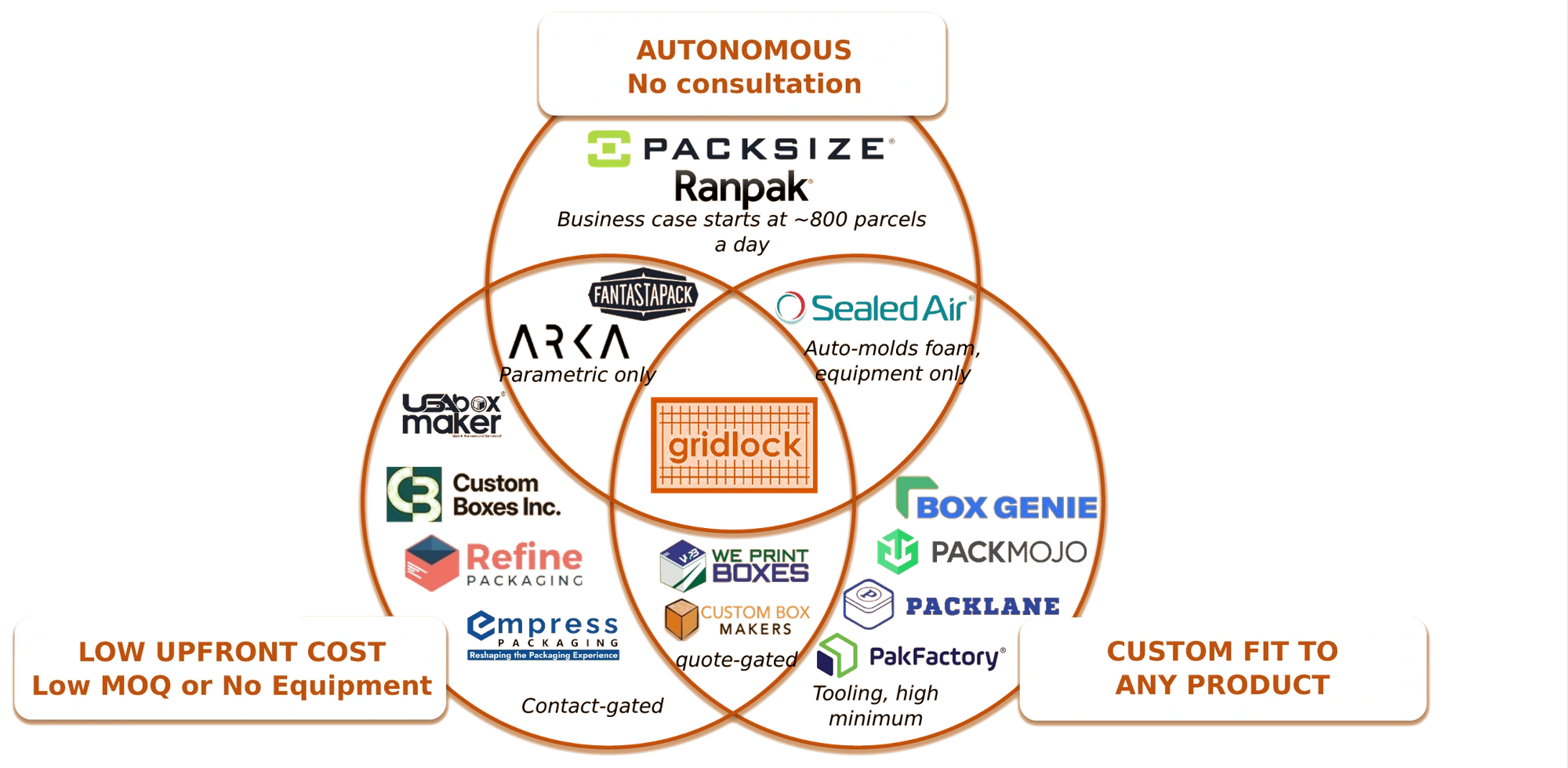
The buying preference points the same way. McKinsey’s B2B sales research finds only about 20% of B2B buyers want an in person sales rep, and TrustRadius’s B2B Buying Disconnect puts 87% of technology buyers as wanting to self serve the purchase. The conventional insert business is built almost entirely around the consultation those buyers are trying to avoid.
Request the pitch deck
Or email gridlockboxllc@gmail.com directly.